
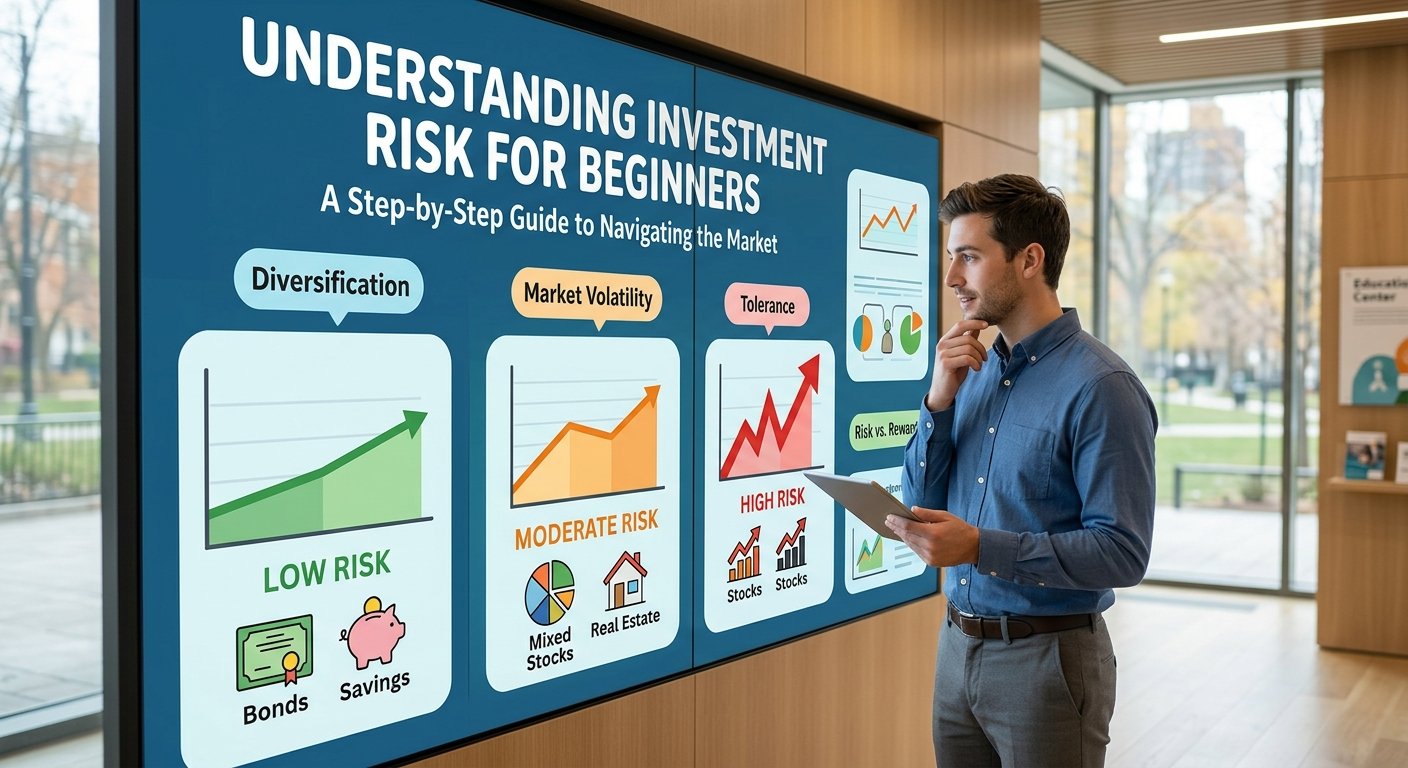
Investing is one way to work toward financial goals, build wealth, and prepare for the future. However, every investment involves some level of uncertainty. The value of your money may increase, decrease, or grow more slowly than expected. For beginners, understanding investment risk is an important step toward making informed financial decisions. Before investing your hard-earned money, it is helpful to understand what risk means, why investments can lose value, and how you can protect yourself from unnecessary financial losses.
Investment risk may sound complicated at first, but the basic idea is simple. It is the possibility that an investment will not perform as expected. You might earn less money than you hoped, lose part of your original investment, or find that you cannot access your money when you need it. By learning how different investments work and what factors affect their performance, you can make decisions that better match your financial goals, budget, and comfort with uncertainty.
What Is Investment Risk?
Investment risk is the possibility of losing money or receiving a return that is different from what you expected. When you invest in stocks, bonds, mutual funds, property, or other financial products, the outcome is not always certain. Some investments experience small changes in value, while others can rise or fall significantly over a short period.
For example, imagine that you invest $1,000 in shares of a company. If the share price increases by 10%, your investment would be worth $1,100 before fees and taxes. However, if the share price falls by 10%, its value would decrease to $900. You would have a $100 unrealized loss if you continued holding the shares, and selling them at that price would turn the loss into a realized loss.
This example shows why it is important to understand the possibility of losses before investing. Even companies that appear successful can experience falling share prices because of changing market conditions, competition, economic uncertainty, or investor expectations.
Investment risk is not limited to losing money directly. Your investment might earn a return that is too low to keep pace with inflation, meaning your money gradually loses purchasing power. You might also need to sell an investment at an inconvenient time because of an unexpected expense. Understanding these different situations can help you prepare more effectively and avoid taking risks you cannot afford.
What Are the Main Types of Investment Risk?
There are several types of investment risk, and each can affect your money in a different way. Learning about the most common risks helps beginners understand why investment values change and why no single investment is suitable for every financial situation.
Market risk is the possibility that an investment will lose value because of changes in the overall financial market. Stock prices can decline during economic slowdowns, periods of uncertainty, or changes in investor confidence. For example, when many investors become concerned about the economy, they may sell shares, causing stock prices to fall across several industries. Even a financially strong company can experience a decline in its share price during a broad market downturn. Diversification can reduce the impact of problems affecting one company or sector, although it cannot eliminate losses caused by a widespread market decline.
Inflation risk is another important concern, particularly for people saving for long-term goals. Inflation occurs when the general prices of goods and services increase over time. If your money earns less than the inflation rate, its purchasing power may decline. For example, suppose your savings earn 3% interest in one year while inflation is 4%. Your account balance increases, but your money may buy less than it could previously. This is why investors often consider both the return they receive and the changing cost of living when planning for the future.
Interest rate risk mainly affects investments such as bonds and can also influence other financial assets. When market interest rates rise, existing bonds with lower fixed interest payments may become less attractive, causing their market prices to fall. When interest rates decline, existing bonds with higher fixed payments may become more valuable. The size of this effect depends on factors such as the bond’s maturity and interest rate. Understanding interest rate risk is useful when comparing bonds and other interest-sensitive investments.
Credit risk is the possibility that a borrower will fail to make required payments or repay money as promised. This risk can affect corporate bonds and other lending arrangements. For example, if a company experiences serious financial difficulties, it may struggle to pay interest to its bondholders or return their original investment. Investors may lose some of their money if the borrower defaults. Reviewing a borrower’s financial condition and credit quality can help investors understand this risk, although it cannot guarantee that payments will be made.
Liquidity risk refers to the possibility that you cannot sell an investment quickly at a reasonable price. Some investments, such as shares in widely traded companies, can generally be sold relatively quickly during market hours. Other investments, such as property or certain private business interests, may take months to sell. If you suddenly need cash, you might have to accept a lower price or wait longer than expected. Keeping emergency savings separate from long-term investments can help reduce the pressure to sell assets at an unfavorable time.
Business risk occurs when a company performs poorly because of competition, rising expenses, management problems, declining demand, or other operational challenges. If a company’s profits decrease, its share price may fall, and investors may receive lower returns than expected. This is one reason investors research a company’s products, financial condition, competitors, and business model before purchasing its shares. Even thorough research cannot predict every future problem, but it can help investors make more informed decisions.
How Can Beginners Manage Investment Risk?
Managing investment risk does not mean avoiding every investment that could lose value. Instead, it means understanding the possible outcomes and choosing an approach that suits your financial circumstances. A thoughtful plan can help you avoid unnecessary risks while keeping your long-term goals in mind.
One useful approach is diversification. Diversification means spreading your money across different investments instead of relying entirely on one company, industry, or asset type. For example, an investor might hold investments across several industries and include a combination of stocks and bonds. If one investment performs poorly, other holdings may help reduce the overall impact. However, diversification does not guarantee profits or prevent all losses, particularly when many markets decline at the same time.
Before investing, consider your financial goals and how soon you will need the money. Someone saving for a house deposit next year may need greater stability and easier access to cash than someone investing for retirement several decades away. Investments that fluctuate significantly in value may be unsuitable for money needed in the near future. Choosing investments based on your time horizon can help reduce the risk of being forced to sell during a market decline.
Building an emergency fund is another important part of preparing financially. Unexpected expenses, such as car repairs, medical bills, or a temporary loss of income, can create pressure to withdraw money from investments. Keeping accessible savings for emergencies can help you handle these expenses without disrupting your investment plan. The amount you need depends on your income, essential expenses, responsibilities, and personal circumstances.
Beginners should also learn about an investment before committing money to it. Understand how the investment generates returns, what fees apply, how easily you can sell it, and what could cause its value to decline. Read the available documentation carefully and be cautious of anyone promising unusually high returns with little or no risk. If you cannot explain how an investment works or where its potential returns come from, take time to research it before making a decision.
Another important habit is avoiding emotional decisions. Financial markets can move sharply, and investors may feel tempted to buy when prices are rising or sell immediately when prices are falling. Decisions based only on fear, excitement, or social media predictions can lead to poor results. Instead, focus on your financial goals, the reasons you made the investment, and whether your circumstances have changed. Regular reviews can help you stay informed without reacting to every short-term market movement.
Finally, remember that taking more risk does not guarantee earning more money. Some investments offer the possibility of higher returns but also carry a greater chance of substantial losses. Your goal should be to find an appropriate balance between potential growth, financial stability, and your ability to withstand losses. If you are unsure about a complex investment or a decision involving a large portion of your savings, consider consulting a qualified financial professional who understands your circumstances.
Understanding the Relationship Between Risk and Return
Risk and return are closely connected in investing. Return is the money you earn or lose on an investment over a particular period, while risk refers to the uncertainty surrounding that outcome. Investors often consider the potential return of an investment alongside the possibility that the result may be worse than expected.
For example, a savings account may provide interest according to its terms, making its returns more predictable than the price movements of stocks. Stocks, on the other hand, may offer greater long-term growth potential but can experience significant declines. The actual outcome depends on the investment, market conditions, fees, taxes, and the period for which you hold it.
It is important to understand that higher risk does not automatically produce higher returns. An investor can take substantial risks and still lose money. A business may fail, an investment may be overpriced, or market conditions may change unexpectedly. The purpose of evaluating risk is therefore not to find the riskiest investment but to understand the possible outcomes and decide whether the potential reward is worth the uncertainty.
Your personal risk tolerance also plays an important role. Risk tolerance describes how comfortable you feel with changes in investment value and the possibility of losses. Some people can remain calm when their investments decline because they have a long time horizon and sufficient financial resources. Others may find the same decline stressful, especially if they need the money soon. Your ability to handle losses financially matters just as much as your emotional comfort with uncertainty.
For beginners, it can be helpful to start by learning about different investment options rather than rushing to invest. Compare their risks, fees, expected holding periods, and access restrictions. A clear understanding of these factors can help you develop realistic expectations and choose a strategy that fits your needs.
Common Investment Mistakes Beginners Should Avoid
New investors sometimes make avoidable mistakes because they focus on potential profits without considering the possibility of losses. One common mistake is putting all available money into a single stock or investment. If that investment performs poorly, a large portion of the investor’s savings may be affected. Spreading investments appropriately can reduce dependence on any one asset, although it does not remove all investment risk.
Another mistake is investing money that is needed for essential expenses or emergencies. Investments that fluctuate in value may not be suitable for money needed to pay rent, household bills, or other near-term obligations. It is generally sensible to understand your current financial commitments and maintain appropriate accessible savings before taking significant investment risks.
Some beginners also follow popular investment trends without conducting their own research. A company or asset may receive considerable attention online, but popularity does not guarantee that its price will rise. Similarly, promises of guaranteed high returns should be treated with caution. Always investigate the investment, the organization offering it, the associated costs, and the possibility of losing money.
Ignoring fees and taxes can also reduce investment returns. Account charges, transaction fees, management expenses, and applicable taxes may affect how much money you ultimately keep. Comparing the total costs of different investment options helps you understand their potential impact on your results.
Finally, avoid assuming that past performance guarantees future success. An investment that performed well in previous years may experience losses in the future. Historical information can help you understand how an investment behaved under different conditions, but it cannot tell you exactly what will happen next. Taking a patient, informed approach is generally more useful than trying to predict every market movement.
Frequently Asked Questions
What is investment risk in simple words?
Investment risk is the possibility that you could lose money or earn less than expected. The level of risk depends on the type of investment, market conditions, and other factors that affect its value or returns.
Can beginners lose money when investing?
Yes, beginners and experienced investors can both lose money. Understanding an investment, researching its risks, diversifying appropriately, and avoiding decisions driven by emotion can help manage risk, but no strategy can guarantee that you will not experience losses.
Which investment is safest for beginners?
There is no single safest investment for everyone. Eligible bank deposits may provide protection under applicable deposit insurance rules, subject to coverage limits and conditions. However, inflation, changing interest rates, access restrictions, and other factors can still affect your financial position. The appropriate option depends on your goals and circumstances.
How can I reduce investment risk?
You can manage investment risk by diversifying your holdings, maintaining emergency savings, understanding fees, researching investments, and matching your investment choices to your time horizon and financial capacity. These steps can reduce certain risks but cannot eliminate them completely.
Is a high investment return always better?
No. A higher potential return may involve greater uncertainty or a higher chance of losing money. Consider both the potential reward and the possible downside before deciding whether an investment is appropriate for you.
Conclusion
Understanding investment risk is an essential part of becoming a more informed investor. Every investment has its own characteristics, and factors such as market movements, inflation, interest rates, credit problems, and liquidity can affect your financial results. Learning about these risks helps you understand why investments change in value and why careful planning matters.
For beginners, the best starting point is to build financial knowledge, establish clear goals, maintain suitable emergency savings, and research investment options before committing money. Diversification and a long-term perspective can help manage certain risks, but they cannot guarantee profits or prevent every loss. By making thoughtful decisions and keeping realistic expectations, you can develop a stronger foundation for managing your money and working toward your financial goals.


Leave a Reply