
Compound interest is one of the most important concepts to understand when learning about personal finance and investing. It allows your money to grow by earning interest on your original amount and on the interest you have already earned. Over time, this process can help savings and investments grow faster.
Whether you are saving for retirement, building an emergency fund, or planning for a major purchase, understanding compound interest can help you make better financial decisions.
The best part is that you do not always need a large amount of money to benefit from compound interest. Starting early, contributing regularly, and giving your money time to grow can make a meaningful difference.
In this guide, you will learn what compound interest is, how it works, how it differs from simple interest, and how you can use it to support your financial goals.
What Is Compound Interest?
Compound interest is interest calculated on both your original principal and the interest accumulated from previous periods.
The principal is the amount of money you initially save or invest. Interest is the money earned on that amount, depending on the account or investment terms.
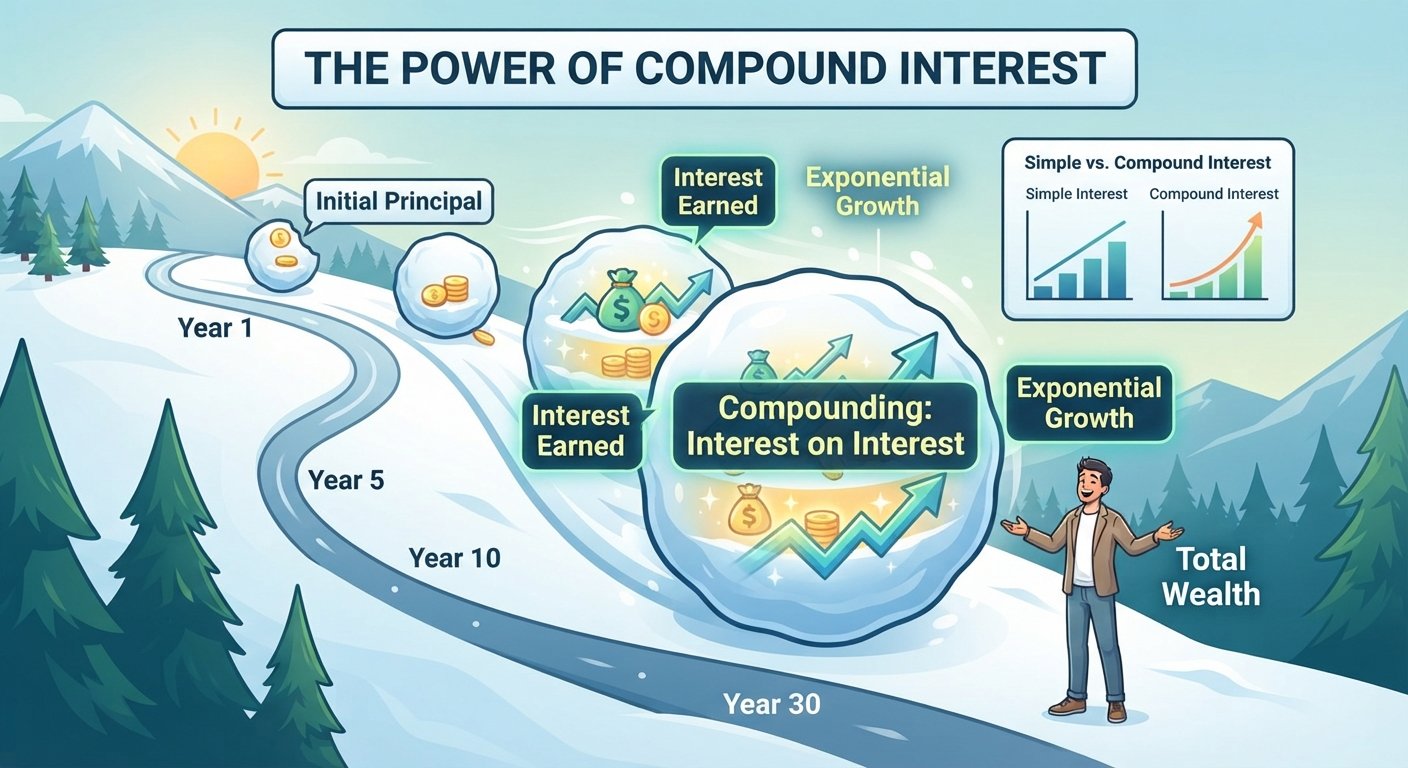
With compound interest, previously earned interest becomes part of the balance used to calculate future interest. This creates the potential for your money to grow at an increasing rate over time.
For example, suppose you deposit $1,000 into an account that earns 5% interest annually. If the interest remains in the account, you earn interest on the growing balance rather than only on your original $1,000.
After the first year, your balance becomes $1,050. In the second year, you earn interest on $1,050 instead of just $1,000.
The longer this process continues, the greater the potential effect of compounding.
How Does Compound Interest Work?
Compound interest works by adding earned interest to your existing balance. Future interest is then calculated on the new balance.
Consider a simple example using an initial deposit of $1,000 and an annual interest rate of 5%.
| Year | Starting balance | Interest earned | Ending balance |
|---|---|---|---|
| Year 1 | $1,000.00 | $50.00 | $1,050.00 |
| Year 2 | $1,050.00 | $52.50 | $1,102.50 |
| Year 3 | $1,102.50 | $55.13 | $1,157.63 |
| Year 4 | $1,157.63 | $57.88 | $1,215.51 |
| Year 5 | $1,215.51 | $60.78 | $1,276.28 |
This example assumes a constant 5% annual return, with interest compounded once per year and no withdrawals, fees, or taxes.
Notice that the interest earned increases each year because the balance grows. You earn $50 in the first year but approximately $60.78 in the fifth year.
This is the basic idea behind compound interest: your accumulated interest can help generate additional interest in future periods.
What Is the Compound Interest Formula?
The compound interest formula helps you estimate how much an initial amount of money may grow over time when interest is compounded at a consistent rate.
[
A=P\left(1+\frac{r}{n}\right)^{nt}
]
Here is what each symbol means:
- A: The final balance, including interest.
- P: The original principal or deposit.
- r: The annual interest rate expressed as a decimal.
- n: The number of compounding periods per year.
- t: The number of years.
For example, an annual interest rate of 5% is written as 0.05 in the formula.
The formula assumes that the interest rate remains constant and that interest stays invested. Actual account terms, fees, taxes, and changing investment returns can affect your results.
For an account that compounds interest once per year, the formula becomes:
[
A=P(1+r)^t
]
This simpler version is useful for understanding how an initial deposit grows when interest is added annually.
Simple Compound Interest Example
Imagine that you deposit $2,000 into a savings account that earns 4% annual interest, compounded once per year.
Your balance would grow approximately as follows:
| Year | Account balance |
|---|---|
| Initial deposit | $2,000.00 |
| After 1 year | $2,080.00 |
| After 2 years | $2,163.20 |
| After 3 years | $2,249.73 |
| After 4 years | $2,339.72 |
| After 5 years | $2,433.31 |
After five years, your balance would be approximately $2,433.31.
Your original deposit was $2,000, so you would have earned approximately $433.31 in interest before any fees or taxes.
This example assumes a constant 4% annual interest rate and no additional deposits or withdrawals.
The result shows that even a relatively small interest rate can contribute to growth when you leave your money untouched for several years.
Compound Interest vs. Simple Interest
Compound interest and simple interest both allow you to earn money on savings or investments, but they calculate interest differently.
Simple interest is calculated only on the original principal. Compound interest is calculated on the principal plus accumulated interest.
Example of Simple Interest
Suppose you deposit $1,000 at a simple interest rate of 5% per year for five years.
You earn $50 every year because the interest is always calculated on the original $1,000.
Over five years, your total interest would be $250, giving you a final balance of $1,250.
Example of Compound Interest
Now suppose the same $1,000 earns 5% annually, compounded once per year.
Your balance would grow to approximately $1,276.28 after five years.
You would earn approximately $276.28 in interest instead of $250.
Comparison Table
| Feature | Simple interest | Compound interest |
|---|---|---|
| Interest calculation | Original principal only | Principal plus accumulated interest |
| Interest earned over time | Usually the same each period | Can increase as the balance grows |
| Growth pattern | Linear under a fixed rate | Compounding growth |
| Five-year example on $1,000 at 5% | $1,250 balance | $1,276.28 balance |
| Long-term effect | Does not earn interest on prior interest | Prior interest can generate more interest |
Both examples assume a fixed annual rate, annual calculations, and no fees or taxes.
Compound interest can produce a larger balance over time when the same positive rate is applied and earned interest remains invested.
Why Is Time Important for Compound Interest?
Time is one of the biggest factors affecting compound growth. The longer your money remains invested at a positive return, the more opportunities it has to earn interest on accumulated interest.
This is why starting early can be valuable, even if you can contribute only a small amount.
Consider a simplified example in which two people invest the same amount at the same annual rate.
Person A starts investing at age 25, while Person B starts at age 35. If both stop investing at age 65, Person A has an additional ten years for their money to compound.
Even if their investment contributions are otherwise identical, Person A may accumulate a larger balance because the money had more time to grow.
The exact difference depends on their contributions, returns, fees, and other factors.
The important lesson is that you do not necessarily need to wait until you have a large amount of money to begin saving. Starting with an affordable amount can give your savings more time to benefit from compounding.
How Regular Contributions Increase Compound Growth
Compound interest can be especially useful when you contribute money regularly.
Instead of making only one deposit, you might add a fixed amount to your savings or investment account every month. Each contribution has the opportunity to earn interest or returns over the remaining period.
For example, imagine that you contribute $100 every month to an investment account that earns an illustrative average annual return of 6%.
If you continue contributing for 20 years, your total contributions would equal $24,000.
Under a simplified monthly compounding calculation, assuming a constant 6% annual rate divided into monthly periods, the ending balance would be approximately $46,200.
| Detail | Amount |
|---|---|
| Monthly contribution | $100 |
| Investment period | 20 years |
| Total money contributed | $24,000 |
| Illustrative annual return | 6% |
| Approximate final balance | $46,200 |
| Approximate growth above contributions | $22,200 |
This illustration assumes contributions are made at the end of each month, a constant monthly rate equivalent to 6% nominal annual interest, and no fees or taxes.
Actual investment returns vary and may be negative. An investment account does not guarantee the return used in this example.
Regular contributions can help you build a consistent saving habit while giving your money more opportunities to grow.
What Is the Difference Between Compound Interest and Compound Returns?
The terms compound interest and compound returns are related, but they are not exactly the same.
Compound interest usually describes interest earned on an account balance or other interest-bearing product. The rate and payment terms may be defined by the product’s agreement.
Compound returns is a broader term often used for investments whose value grows through reinvested returns. These returns may come from interest, dividends, capital gains, or a combination of sources.
For example, a savings account may earn compound interest according to its stated terms. A diversified investment fund may generate compound returns when distributions are reinvested and its holdings increase in value.
The difference matters because investment returns are not usually fixed. Stocks and funds can lose value, and a positive average return does not mean that an investment grows by the same percentage every year.
How Often Can Interest Be Compounded?
Interest can be compounded at different intervals, depending on the account or investment terms.
Common compounding schedules include:
- Annually: Interest is compounded once per year.
- Semiannually: Interest is compounded twice per year.
- Quarterly: Interest is compounded four times per year.
- Monthly: Interest is compounded twelve times per year.
- Daily: Interest is calculated or compounded each day, according to the product’s terms.
When the nominal annual rate is the same and interest is actually credited more frequently, more frequent compounding can produce a slightly higher balance.
For example, a deposit earning 5% nominal annual interest may grow differently depending on whether the interest is compounded annually, monthly, or daily.
However, the advertised rate alone does not tell the whole story. Check whether a provider quotes a nominal rate or an effective annual rate, and compare fees, restrictions, and account conditions.
How to Use Compound Interest to Build Wealth
Understanding compound interest is useful, but applying the concept consistently is what makes it relevant to personal finance.
1. Start Saving as Early as You Can
Beginning early gives your money more time to accumulate interest or investment returns. You do not need to start with a large amount.
Choose an amount that fits your budget and helps you work toward your goals without compromising essential expenses.
2. Make Regular Contributions
Set up a regular savings contribution if your account allows it. You might transfer money each payday or contribute a fixed amount each month.
Consistency can help you build savings gradually and reduce the temptation to spend money that you intended to save.
3. Reinvest Interest and Dividends
If your financial goal is long-term growth, leaving interest in the account or reinvesting eligible investment distributions can help your balance compound.
Before reinvesting, make sure you understand any tax consequences, charges, and risks.
4. Compare Interest Rates and Fees
Different savings accounts and investment products may offer different rates and conditions.
Compare the effective annual rate where available, account charges, withdrawal restrictions, minimum balance requirements, and the reliability of the provider.
A higher advertised rate is not always the best option if it comes with significant restrictions or additional risks.
5. Avoid Unnecessary Withdrawals
Withdrawing money reduces the balance that can earn future interest. Frequent withdrawals can slow your progress toward a savings goal.
However, savings should serve your needs. It is sensible to use emergency funds when genuine emergencies occur rather than relying on expensive debt.
6. Review Your Progress
Check your savings periodically to see whether your contributions and interest earnings are helping you move toward your goals.
You may need to adjust your contribution amount as your income, expenses, or financial responsibilities change.
Can Compound Interest Work Against You?
Yes. Compound interest can help your savings grow, but compounding can also increase the cost of debt.
When you carry a balance on a credit card or another loan that charges interest, unpaid interest and fees may increase the amount you owe, depending on the loan’s terms and applicable rules.
For example, a credit card balance that remains unpaid can become more expensive over time if interest continues to accrue. If new purchases are added, the debt may grow even faster.
To manage debt effectively:
- Pay bills on time to avoid unnecessary penalties.
- Pay more than the minimum when you can afford to do so.
- Prioritize high-interest debt where appropriate.
- Avoid taking on new debt that does not fit your budget.
- Review the interest rate and terms of every loan.
If you have expensive debt, reducing it may provide a more predictable financial benefit than pursuing uncertain investment returns.
Common Mistakes to Avoid With Compound Interest
Even though compound interest is easy to understand in principle, several mistakes can lead to unrealistic expectations or poor financial decisions.
Expecting Guaranteed High Returns
A high advertised return does not automatically mean a good investment. Be cautious of anyone promising guaranteed profits that appear unusually large or risk-free.
Starting Without a Savings Plan
If you save only when money is left over, you may struggle to contribute consistently. A realistic budget can help you establish a regular savings habit.
Ignoring Fees and Taxes
Account charges, investment expenses, and taxes may reduce the amount of money that remains available to compound. Review these costs when comparing financial products.
Withdrawing Money Too Frequently
Taking money out of an account reduces the balance available to earn future interest. Plan for short-term expenses separately when possible.
Confusing Average Investment Returns With Guaranteed Interest
A savings account may have a stated interest rate for a particular period, subject to its terms. Stock market returns, by contrast, fluctuate and can be negative. Do not assume that an illustrative investment return will occur every year.
Waiting Until You Have More Money
You may be able to start saving with a small contribution. Waiting for a perfect financial situation can delay the development of useful habits, although essential expenses and high-interest debt should still be considered first.
Frequently Asked Questions
What is compound interest in simple words?
Compound interest means earning interest on your original money and on the interest you have already earned. If you leave your interest in the account, your balance may grow over time.
How does compound interest make money grow faster?
As interest accumulates, it becomes part of the balance used to calculate future interest. This means that, under a positive fixed rate with no withdrawals, the amount of interest earned can increase over time.
Is compound interest better than simple interest?
With the same positive rate and initial amount, compound interest generally produces a larger balance over time when interest remains invested. The difference becomes more noticeable over longer periods.
How much can $1,000 grow with compound interest?
The result depends on the interest rate, compounding frequency, and time period. For example, $1,000 growing at 5% annually, compounded once per year, would become approximately $1,276.28 after five years, before any fees or taxes.
How often should interest be compounded?
The schedule depends on the financial product. More frequent compounding can increase the final balance when comparing the same nominal annual rate, but fees, restrictions, and the effective annual rate should also be considered.
Can I earn compound interest by investing in stocks?
Stocks do not generally pay fixed interest like an interest-bearing savings account or bond. However, investments may benefit from compounding when dividends are reinvested and investment returns remain invested. Stock market returns are uncertain, and losses are possible.
Does compound interest apply to savings accounts?
Yes, many savings accounts pay interest that can compound. The actual schedule, rate, and eligibility conditions depend on the bank and account terms.
Can compound interest make me rich?
Compound growth can help build wealth over time, but it does not guarantee financial success. Your contributions, available returns, time horizon, fees, taxes, and financial decisions all affect the outcome.
Is compound interest risk-free?
The mathematical process itself is not a guarantee of safety. The risk depends on the account or investment. Some bank deposits may qualify for protection under local deposit insurance rules, while investments can lose value.
Conclusion
Compound interest is a powerful financial concept because it allows accumulated interest to generate additional interest over time. By saving consistently, reinvesting eligible earnings, and allowing your money time to grow, you may be able to build a larger financial balance.
The most important factors are your starting amount, contribution habits, interest rate or investment returns, compounding frequency, and the length of time your money remains invested.
Start by setting a realistic financial goal, reviewing your budget, and choosing an appropriate savings or investment product. Compare rates and fees carefully, understand the risks, and avoid relying on unrealistic promises.
Compound interest is not a shortcut to guaranteed wealth, but understanding how it works can help you make better financial decisions and develop habits that support your long-term goals.
Financial Disclaimer
This article is for educational and informational purposes only and does not constitute financial, investment, tax, or legal advice. Interest rates, account conditions, investment returns, fees, and tax rules vary. Investment returns are not guaranteed, and investments may lose value. Review the terms of any financial product carefully and consult a qualified professional when appropriate before making financial decisions.


Leave a Reply