
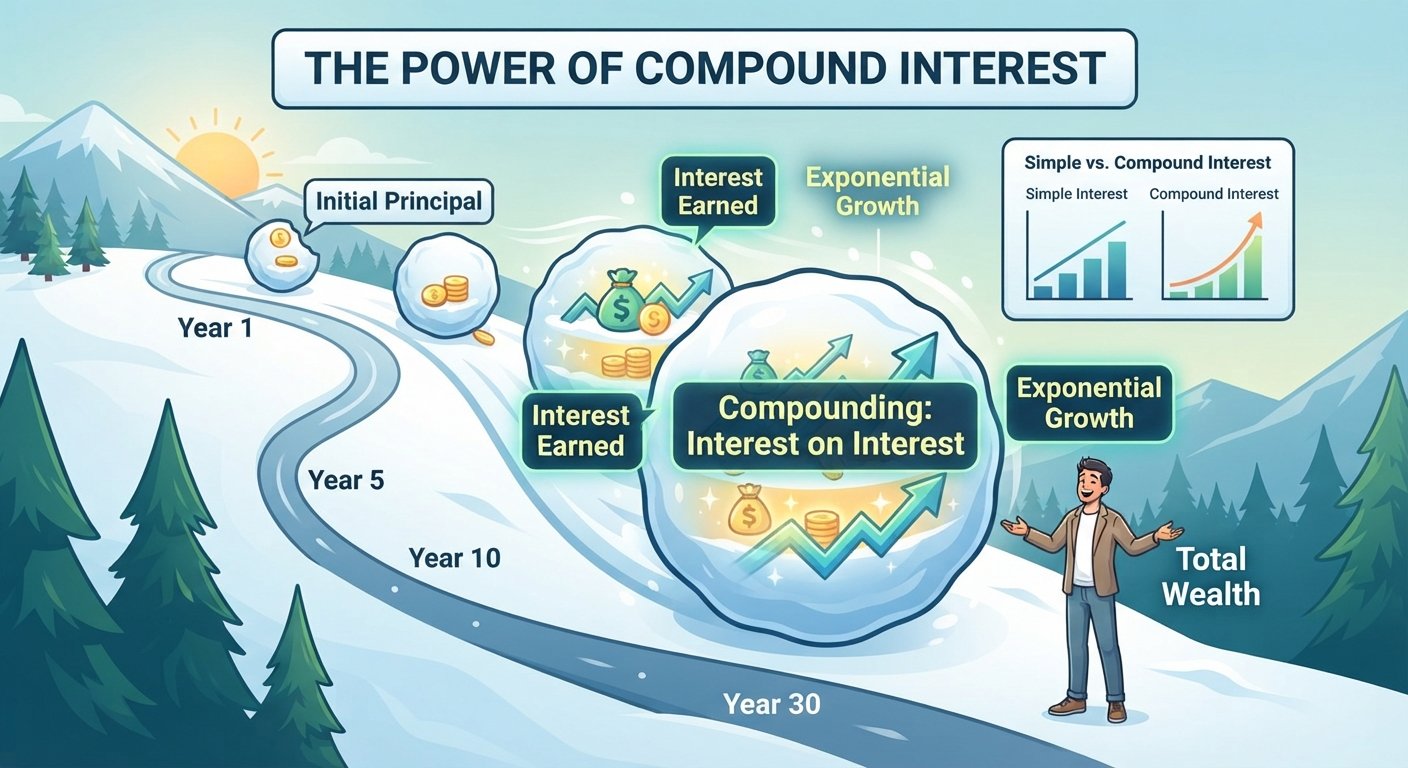
Compound interest is one of the most important concepts to understand when learning about saving, investing, and managing money. It can help your savings grow over time because you earn interest not only on your original money but also on the interest you have already earned.
Whether you are opening a savings account, planning for the future, or learning basic personal finance, understanding compound interest can help you make better financial decisions. In this guide, we will explain what compound interest is, how it works, and how to calculate it using simple examples.
What Is Compound Interest?
Compound interest is the interest earned on both your original amount of money and the interest accumulated over time. Unlike simple interest, which is calculated only on the original amount, compound interest allows your money to grow faster as interest builds upon previous interest.
For example, imagine you deposit $1,000 into a savings account that earns 5% annual interest. After the first year, you earn $50 in interest, bringing your balance to $1,050. In the second year, you earn interest on $1,050 instead of just $1,000.
This process continues year after year, helping your savings grow over time.
How Does Compound Interest Work?
Compound interest works by adding earned interest to your account balance. The next interest calculation is then based on this larger amount.
Here is a simple breakdown:
- Start with an initial amount: This is the money you deposit or invest.
- Earn interest: Your balance grows according to the interest rate.
- Add the interest: The earned interest becomes part of your balance.
- Earn interest again: In the next period, interest is calculated on the new balance.
- Repeat the process: Your money can continue growing as long as interest accumulates.
The longer you leave your money invested or saved, the more opportunity compound interest has to increase your balance, assuming a positive interest rate and no withdrawals or fees.
Compound Interest Formula
You can calculate compound interest using the following formula:
A = P(1 + r/n)^(nt)
Where:
- A = Final balance, including interest
- P = Initial principal amount
- r = Annual interest rate expressed as a decimal
- n = Number of times interest is compounded per year
- t = Number of years
To calculate the compound interest earned, subtract the original principal from the final balance:
Compound Interest = A − P
For example, if you deposit $1,000 at an annual interest rate of 5%, compounded once per year for three years, the calculation is:
A = 1,000 × (1 + 0.05)³
A = $1,157.63
Your total interest earned would be approximately $157.63, assuming the rate remains unchanged and no additional deposits, withdrawals, or fees apply.
Simple Examples of Compound Interest
Let’s look at a few practical examples to understand how compound interest can help money grow.
Example 1: Saving $1,000 for One Year
Suppose you deposit $1,000 into a savings account that pays 5% annual interest, compounded annually.
- Initial deposit: $1,000
- Annual interest rate: 5%
- Interest earned in the first year: $50
- Final balance: $1,050
After one year, your savings increase by $50. If you keep the money in the account, the next year’s interest will be calculated on the new balance.
Example 2: Saving $1,000 for Five Years
Now imagine you leave the same $1,000 in an account earning 5% annual interest, compounded once per year.
| Year | Starting Balance | Interest Earned | Ending Balance |
|---|---|---|---|
| 1 | $1,000.00 | $50.00 | $1,050.00 |
| 2 | $1,050.00 | $52.50 | $1,102.50 |
| 3 | $1,102.50 | $55.13 | $1,157.63 |
| 4 | $1,157.63 | $57.88 | $1,215.51 |
| 5 | $1,215.51 | $60.78 | $1,276.28 |
After five years, your $1,000 grows to approximately $1,276.28. You earn $276.28 in interest without making additional deposits.
Notice that the interest earned increases each year because the balance grows.
Example 3: Saving Money for Ten Years
Suppose you deposit $2,000 into an account earning 5% annual interest, compounded annually, and leave it untouched for ten years.
Using the compound interest formula:
A = 2,000 × (1.05)¹⁰
Your final balance would be approximately $3,257.79.
That means you would earn about $1,257.79 in interest over ten years, before considering taxes, fees, or inflation.
This example shows why time can make a significant difference when saving money.
Compound Interest vs. Simple Interest
Compound interest and simple interest both allow you to earn interest, but they calculate it differently.
| Feature | Compound Interest | Simple Interest |
|---|---|---|
| Interest calculation | Original amount plus accumulated interest | Original amount only |
| Growth over time | Can accelerate as interest accumulates | Usually grows at a constant rate |
| Long-term effect | Often produces more interest | Usually produces less interest at the same positive rate |
| Common applications | Savings accounts and investments | Some loans and fixed-interest arrangements |
For example, a $1,000 deposit earning 5% annual interest for five years would earn $250 in simple interest, resulting in a balance of $1,250.
With annual compounding at the same rate, the balance would grow to approximately $1,276.28.
The difference comes from earning interest on previously accumulated interest.
Why Is Compound Interest Important?
Compound interest is important because it can help people build savings and grow investments over long periods. Understanding how it works can make it easier to plan for future expenses and financial goals.
1. It Helps Your Savings Grow
When interest stays in your account, it can earn additional interest in future periods. This allows your savings to grow without requiring you to contribute more money.
2. Time Can Increase Its Benefits
The longer money earns compound interest, the more time it has to accumulate returns. Starting to save earlier can therefore make a meaningful difference, even when the initial amount is relatively small.
3. Regular Contributions Can Make a Difference
Adding money to your savings account regularly can increase the amount available to earn interest. When contributions and interest accumulate over time, your balance may grow more than it would with a single deposit.
Actual results depend on the interest rate, contribution schedule, account terms, fees, and other factors.
4. It Can Help With Long-Term Financial Planning
Compound interest can be useful when planning for education, retirement, emergencies, or other future expenses. Understanding the concept can help you compare savings products and evaluate different time horizons.
What Is the Difference Between Compounding Daily, Monthly, and Annually?
Compounding frequency refers to how often interest is added to the balance.
- Annual compounding: Interest is added once per year.
- Monthly compounding: Interest is added twelve times per year.
- Daily compounding: Interest is calculated and added daily, according to the account’s terms.
When the nominal annual interest rate is the same and all other conditions are equal, more frequent compounding generally results in a slightly higher balance.
For example, a deposit earning a nominal annual rate of 5% may produce different results depending on whether interest is compounded annually, monthly, or daily.
However, it is important to compare the actual advertised rate, such as the annual percentage yield where applicable, rather than relying on compounding frequency alone.
How Can You Take Advantage of Compound Interest?
You do not need a large amount of money to begin learning about compound interest. The following habits may help you make better use of it.
Start saving early. Beginning sooner gives your savings more time to accumulate interest.
Save consistently. Regular deposits can increase your principal and potential future interest.
Reinvest your earnings. Leaving earned interest in an account allows it to contribute to future growth.
Compare interest rates. Review the rate, fees, withdrawal restrictions, and compounding terms before choosing an account.
Be realistic about returns. Interest rates can change, and investment returns are not guaranteed. Consider inflation and taxes when evaluating long-term growth.
Avoid unnecessary withdrawals. Taking money out reduces the balance available to earn future interest.
Can Compound Interest Work Against You?
Yes. Compound interest can also increase the amount you owe when it applies to debt.
For example, if interest on a debt is added to the outstanding balance and further interest is charged on that larger balance, the amount owed can grow over time.
This may happen with certain loans or credit products, depending on their terms and applicable rules. Fees, penalties, and missed payments can increase the cost further.
That is why it is important to understand how interest is calculated on both savings and borrowing. Paying attention to interest rates and repayment terms can help you avoid unnecessary costs.
Common Mistakes to Avoid
When learning about compound interest, keep these common mistakes in mind:
- Confusing interest earned with the final balance: The final balance includes your original deposit and accumulated interest.
- Ignoring fees and taxes: These expenses can reduce the amount you keep.
- Assuming rates never change: Some savings accounts have variable interest rates.
- Expecting guaranteed investment returns: Investments can lose value, and their returns may fluctuate.
- Forgetting inflation: Your balance may increase while the purchasing power of your money changes.
- Starting without a clear goal: A savings target and time frame can help you choose an appropriate financial approach.
Understanding these details can help you make more informed decisions about your money.
Frequently Asked Questions (FAQs)
1. What is compound interest in simple words?
Compound interest is interest earned on your original money and on interest accumulated in previous periods. It allows savings to grow as interest builds over time.
2. How do you calculate compound interest?
Use the formula A = P(1 + r/n)^(nt), where P is the initial amount, r is the annual interest rate as a decimal, n is the number of compounding periods per year, and t is the number of years. Subtract the original principal from the final balance to find the interest earned.
3. Is compound interest better than simple interest?
For savings earning the same positive rate over the same period, compound interest generally produces more interest because previously earned interest can also earn interest. The result depends on the specific terms and calculation method.
4. How often can interest be compounded?
Depending on the account or financial product, interest may be compounded annually, semiannually, quarterly, monthly, or daily. Check the product’s terms to understand how your interest is calculated.
5. Can I earn compound interest with a small amount of money?
Yes. Compound interest can apply to small balances as well as large ones, provided the financial product offers interest and its terms allow interest to accumulate. The amount earned will depend on your balance, rate, and time.
6. Does compound interest guarantee that my money will grow?
No. A savings account with a positive interest rate may p



Leave a Reply