
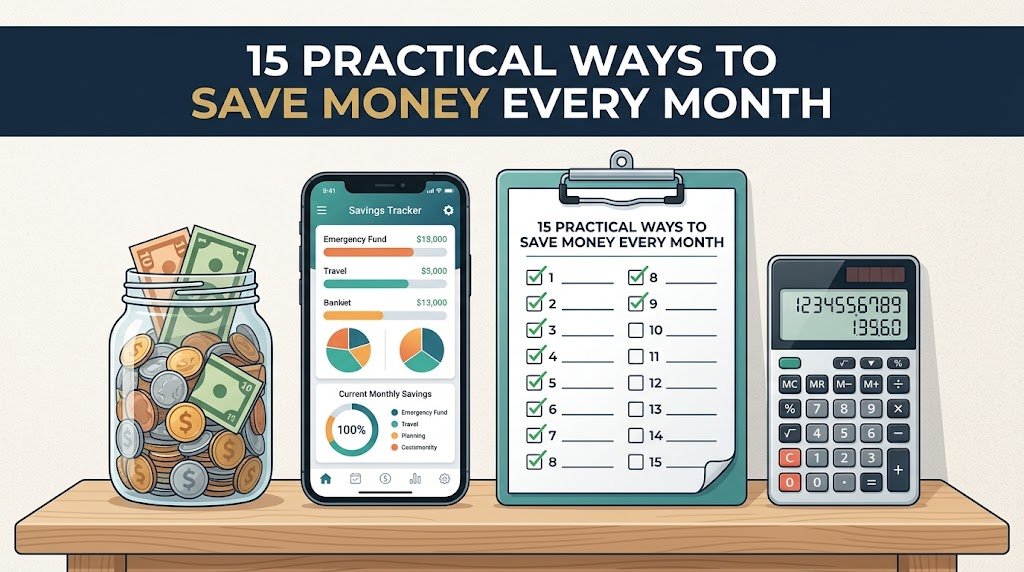
Saving money every month can help you build financial security, prepare for unexpected expenses, and work toward important goals. However, saving is not always easy. Rent, groceries, utility bills, transportation, and other everyday costs can consume a large portion of your income before you have a chance to put anything aside.
The good news is that you do not need a high salary to develop better saving habits. Small changes in your spending, combined with a realistic monthly plan, can help you save money consistently over time.
The key is to understand where your money goes, identify expenses you can reasonably reduce, and make saving part of your regular financial routine.
In this guide, you will discover 15 practical ways to save money every month, from planning your budget and reducing household expenses to avoiding impulse purchases and building an emergency fund.
Why Is Saving Money Every Month Important?
Regular saving gives you more control over your finances and helps you prepare for future needs.
When you consistently set aside a portion of your income, you can build an emergency fund, reduce dependence on borrowing, and prepare for planned expenses such as education, travel, or household purchases.
Saving also creates flexibility. If your circumstances change, having money available may help you cover essential expenses without immediately relying on credit cards or loans.
You do not have to save a large amount from the beginning. Developing a sustainable habit is often more useful than setting an ambitious target that you cannot maintain.
1. Create a Realistic Monthly Budget
One of the most effective ways to save money is to create a monthly budget. A budget helps you understand how much you earn, how much you spend, and how much you can reasonably save.
Start by calculating your take-home income after taxes and relevant deductions. Then list your regular expenses, including housing, groceries, utilities, transportation, insurance, and debt payments.
Next, review your flexible spending, such as dining out, entertainment, shopping, and subscriptions. These categories may offer opportunities to reduce costs without affecting your essential needs.
For example, if you earn $3,000 per month and spend $2,850, you have only $150 remaining before accounting for any omitted expenses. Reviewing your budget may help you identify realistic changes that allow you to save more.
Set a monthly savings target that fits your actual circumstances. If you can initially save only $25 or $50, start there and increase the amount when possible.
A budget should guide your decisions rather than restrict every purchase. Review it regularly and adjust it whenever your income or expenses change.
2. Track Your Daily Expenses
Many people underestimate how much they spend on small purchases. Coffee, snacks, takeaway meals, parking, and inexpensive online orders can gradually add up.
Tracking your expenses helps you identify these patterns and understand where your money goes.
You can use a notebook, spreadsheet, or budgeting app. Record each purchase with its amount and category, and review your spending at the end of every week.
For example, spending $5 each workday on an optional purchase adds up to approximately $100 over a 20-workday month.
That does not mean you must eliminate every small pleasure. Instead, tracking helps you decide which purchases provide value and which ones you could reduce.
After tracking expenses for a month, identify one or two categories where small adjustments could make a meaningful difference.
3. Plan Your Grocery Shopping
Groceries are a regular household expense, making them a useful place to look for potential savings.
Shopping without a plan can lead to duplicate purchases, unnecessary snacks, and food that expires before you use it.
Before going shopping, check what you already have at home and prepare a list of the items you need. Plan a few meals around ingredients you already own, and compare prices where practical.
You can also reduce grocery costs by:
- Buying seasonal fruits and vegetables.
- Comparing unit prices rather than package prices alone.
- Preparing meals at home more often.
- Using leftovers safely instead of wasting food.
- Avoiding shopping when you are hungry if it leads to unnecessary purchases.
- Choosing store brands when their quality and value meet your needs.
Buying in bulk can sometimes save money, but only when you can use the products before they expire and have enough storage space.
The goal is to spend less on unnecessary food purchases while still buying the groceries your household needs.
4. Reduce Dining Out and Takeaway Spending
Restaurant meals and takeaway food can be convenient, especially when you have a busy schedule. However, frequent purchases may cost more than preparing similar meals at home.
You do not have to stop dining out completely to save money. Instead, decide how often you want to eat out and include a reasonable allowance in your budget.
For example, you might prepare lunch at home on several workdays and reserve restaurant meals for planned occasions.
Keeping simple ingredients available can make home cooking easier. Sandwiches, salads, soups, rice dishes, and other quick meals can help reduce the temptation to order food when you are tired.
If you enjoy coffee from a café, you could make it at home on some days rather than buying it every day.
Compare your actual spending before making changes. Even reducing one or two unnecessary takeaway orders each week may free up money for savings, depending on local prices.
5. Cancel Unused Subscriptions
Subscriptions can quietly reduce your available income because many payments renew automatically.
Review your bank statements and payment accounts for streaming services, memberships, premium applications, cloud storage, and other recurring charges.
For each subscription, ask yourself:
- Do I use this service regularly?
- Does it provide enough value for its cost?
- Is there a less expensive plan that meets my needs?
- Am I paying for another service that offers similar features?
Cancel subscriptions you no longer need and review annual renewals before they occur.
For example, canceling three unused subscriptions that cost $10 each per month would free up $30 monthly, or $360 over a year, assuming the prices remain unchanged.
Keep subscriptions that genuinely support your work, education, or enjoyment. The purpose is to remove unnecessary expenses rather than eliminate every paid service.
6. Set Up Automatic Savings
Saving money becomes easier when you make it a regular part of your financial routine.
If your income is predictable, consider arranging an automatic transfer from your everyday account to a separate savings account after payday.
For example, transferring $50 each week would result in approximately $200 to $250 in monthly contributions, depending on the number of transfer dates in the month.
Choose an amount that leaves enough money for essential bills, food, transportation, and other commitments.
If your income is irregular, you may prefer to save manually after each payment arrives and your immediate expenses are covered.
Automatic savings can reduce the temptation to spend money that you intended to save. However, monitor your account balance to avoid overdrafts or missed payments.
Start with a manageable amount and increase it gradually as your financial situation improves.
7. Reduce Electricity and Utility Bills
Utility expenses can vary depending on your location, household size, weather, and energy prices. Nevertheless, reviewing how you use electricity, water, and heating may reveal opportunities to save money.
Practical steps include:
- Turn off lights when they are not needed.
- Use energy-efficient lighting when appropriate.
- Switch off electronics that consume unnecessary standby power where practical.
- Wash full loads of laundry when suitable.
- Adjust heating and cooling settings sensibly.
- Repair leaking taps and reduce unnecessary water use.
- Compare utility plans if your provider and location offer alternatives.
You can also review previous bills to identify seasonal changes or unusually high usage.
Avoid making expensive upgrades solely for potential savings without comparing their upfront cost with the likely reduction in bills.
Small changes that cost little or nothing are often a sensible place to start.
8. Compare Prices Before Making Purchases
Buying the first product you see can mean missing a better price or a more suitable alternative.
Before making a significant purchase, compare prices across reputable retailers and consider delivery charges, taxes, warranties, and return policies.
For everyday items, compare unit prices to determine which package offers better value.
However, the cheapest option is not always the most economical. A low-cost product that breaks quickly may cost more over time than a durable alternative.
Use discounts and coupons when they apply to items you already intended to buy. Avoid purchasing unnecessary products simply because they are on sale.
A simple comparison before buying can help you make more informed spending decisions and protect your monthly budget.
9. Avoid Impulse Buying
Impulse purchases happen when you buy something without planning for it. They may be triggered by advertisements, limited-time offers, social media, or the excitement of finding a product you like.
Repeated unplanned purchases can make it harder to save because the money was not included in your budget.
One useful strategy is to introduce a waiting period before purchasing nonessential items.
For example, wait 24 hours before making a small discretionary purchase and several days before buying a more expensive item. During that time, consider whether you need the product, can afford it, and would still want it without the promotion.
You can also remove shopping applications from your home screen, unsubscribe from promotional emails, and avoid saving payment information on shopping websites if it encourages unplanned spending.
You do not need to stop buying things you enjoy. Planning purchases can help ensure they fit your priorities.
10. Review Your Phone, Internet, and Insurance Plans
Regular service bills may increase over time or include features you no longer use.
Review your phone, internet, and insurance plans periodically to check whether you are paying for unnecessary services or coverage that does not fit your current needs.
You might be able to:
- Switch to a more suitable mobile data plan.
- Remove unused add-ons.
- Compare internet providers where alternatives are available.
- Ask your provider about lower-cost plans.
- Review insurance coverage and compare equivalent policies.
When comparing insurance, make sure the coverage, exclusions, deductibles, and limits are appropriate. Choosing a cheaper policy that leaves you without important protection may create larger costs later.
For each service, compare the potential savings with any cancellation fees or contract restrictions.
Even a modest reduction in a recurring bill can create ongoing savings if the change remains suitable for your needs.
11. Pay Attention to High-Interest Debt
Debt payments can make saving difficult, particularly when interest charges consume a significant portion of your monthly income.
If you carry high-interest credit card balances or other expensive debt, reviewing your repayment plan may help reduce the total cost of borrowing.
Start by listing your balances, interest rates, minimum payments, and due dates. Continue making required minimum payments while considering whether you can direct additional money toward a high-interest balance.
You should also consider keeping some accessible emergency savings. Without any reserve, an unexpected expense could force you to borrow again.
Avoid taking out new loans simply to maintain optional spending. If debt payments are becoming unmanageable, contact your lender to discuss possible arrangements or seek guidance from a reputable nonprofit credit counselor where available.
The best approach depends on your income, interest rates, financial obligations, and immediate needs.
12. Use a Shopping List and Avoid Food Waste
Food waste can increase household costs because you pay for items that are never consumed.
Before shopping, check your refrigerator, freezer, and pantry. Build your meal plan around ingredients you already have and purchase only what you need.
Store food according to its requirements, freeze suitable items before they spoil, and use leftovers safely.
You can also keep a simple list of items that need to be used soon. This can help you plan meals before buying more food.
Be careful with bulk purchases and multi-buy promotions. Buying more is only a saving when you actually use the products and the total cost represents good value.
Reducing waste can help your grocery budget go further without requiring you to compromise on essential nutrition.
13. Set Clear Financial Goals
Saving becomes easier when you have a clear reason for doing it.
Instead of setting a vague goal such as “save more money,” identify what you want to achieve and how much it may cost.
Your goals might include:
- Building an emergency fund.
- Saving for education or training.
- Preparing for a planned move.
- Buying a necessary household item.
- Saving for a major purchase.
- Preparing for future family expenses.
For example, if you want to save $1,200 over 12 months, you would need to contribute approximately $100 each month, assuming no interest or withdrawals.
Write down your goal, target amount, and timeline. Track your progress regularly and adjust your contributions when necessary.
If you have several goals, prioritize them according to urgency and importance. Essential emergency savings and expensive debt may deserve attention before optional purchases.
14. Find Ways to Increase Your Income
Reducing expenses is useful, but there may be limits to how much you can cut, especially if most of your income already goes toward essential needs.
In that situation, increasing income may be another option.
Depending on your skills and circumstances, possibilities could include:
- Applying for a higher-paying position.
- Seeking additional hours at your current job.
- Learning a skill that may improve future earning opportunities.
- Taking suitable freelance projects.
- Selling unused items you no longer need.
- Offering a service based on your existing experience.
Consider the costs, time commitment, and reliability of any additional income opportunity. Avoid schemes that promise guaranteed earnings or require suspicious upfront payments.
If you earn additional money, decide in advance how much you want to direct toward savings, debt repayment, and other priorities.
Increasing income is not always possible immediately, but exploring realistic options may help when expense reductions alone are insufficient.
15. Review Your Progress Every Month
The final step is to review your results regularly.
At the end of each month, compare your actual spending with your budget. Identify which changes helped you save money and which expenses were higher than expected.
You can use a simple table to monitor your progress.
| Monthly financial measure | Example amount |
|---|---|
| Take-home income | $3,000 |
| Essential expenses | $1,900 |
| Flexible spending | $700 |
| Savings contribution | $300 |
| Other planned expenses or buffer | $100 |
| Total allocated | $3,000 |
These figures are illustrative and should be adjusted to match your own circumstances.
If you planned to save $300 but managed to save only $150, review the reason before changing your goal. An unexpected repair may have been unavoidable, or your budget may have underestimated a regular expense.
Use what you learn to make next month’s plan more realistic.
You do not need to make every change at once. Choose a few practical actions, maintain them consistently, and build on your progress over time.
How Much Money Should You Save Every Month?
The amount you should save depends on your income, essential expenses, debts, and financial goals.
Some people use the 50/30/20 budget rule as a starting point. This method suggests allocating 50% of take-home income to needs, 30% to wants, and 20% to savings and debt repayment.
However, these percentages are not suitable for everyone. People facing high housing costs or limited income may need to allocate more money to essentials.
If you cannot save 20% of your income, start with an amount you can afford. Even $25, $50, or $100 per month can help you develop the habit.
For example, saving $100 monthly would produce $1,200 in contributions over a year, assuming no withdrawals or interest. Increasing the amount when your circumstances allow can help you progress faster.
The most important factor is consistency, not meeting a particular percentage at all costs.
Common Money-Saving Mistakes to Avoid
While trying to save money, avoid these common mistakes:
Setting unrealistic targets: Extremely restrictive plans can be difficult to maintain. Choose a savings target that fits your actual income and expenses.
Ignoring irregular expenses: Annual bills, repairs, and seasonal costs can disrupt your budget. Plan for predictable expenses in advance.
Focusing only on small purchases: Reducing minor expenses can help, but major costs such as housing, transportation, and recurring bills may have a greater effect on your budget.
Buying unnecessary items on sale: A discount does not create savings if you would not otherwise have purchased the item.
Using emergency savings for planned purchases: Keep money for predictable goals separate from your emergency fund whenever possible.
Forgetting to review progress: Regular reviews help you identify what works and where adjustments are needed.
Frequently Asked Questions
What is the easiest way to save money every month?
Start by tracking your expenses and creating a realistic budget. Then choose one or two changes, such as reducing unused subscriptions or planning grocery purchases. Set a manageable savings target and review your progress each month.
Can I save money on a low income?
Yes, although your options may be limited if most of your income covers essential expenses. Start with a small amount if possible, prioritize necessities, and explore realistic ways to reduce costs or increase income.
How can I save money without changing my lifestyle too much?
Focus on expenses that provide little value, such as unused subscriptions, avoidable fees, and purchases you later regret. You may be able to save without eliminating activities that matter to you.
Should I save money or pay off debt first?
The answer depends on your circumstances. Maintaining some emergency savings can help you handle unexpected expenses, while high-interest debt can be expensive. Consider balancing an initial emergency reserve with required debt payments and additional repayment.
How long does it take to build an emergency fund?
The timeline depends on your target and monthly contributions. If your goal is $3,000 and you save $150 per month, it would take 20 months to reach that amount, assuming no withdrawals or interest.
Is it better to save money in a bank account?
An accessible savings account may be suitable for emergency funds and short-term goals. Compare fees, withdrawal rules, deposit protection, and interest rates available in your country before choosing an account.
Final Thoughts
Saving money every month does not require dramatic lifestyle changes. It starts with understanding your expenses, creating a realistic budget, and choosing practical habits that help you spend more intentionally.
From planning grocery shopping and canceling unused subscriptions to automating savings and reviewing financial goals, each change can contribute to a stronger financial routine.
Choose two or three strategies from this list and start applying them this month. Once those habits become easier, introduce additional changes that suit your needs.
Remember that successful saving is not about eliminating everything you enjoy. It is about using your money in a way that supports both your current needs and your future financial security.
Disclaimer: This article provides general educational information and is not individualized financial advice. Your saving options and financial priorities may vary depending on your income, location, expenses, and personal circumstances.



Leave a Reply